10 Essential Tips for Choosing Food Manufacturing Equipment

Choosing the right food manufacturing equipment can significantly impact production efficiency and product quality. A recent report from IBISWorld indicates that the food processing equipment market is projected to reach $32 billion by 2024. This growth reflects the increasing demand for automation and efficiency in food production.

Experts emphasize the importance of selecting appropriate equipment. John Adams, a veteran in food manufacturing, states, "Investing wisely in equipment can revolutionize your production line." His insight highlights how well-chosen equipment can enhance productivity and reduce waste. However, many companies overlook critical factors during selection.

Navigating the equipment landscape can be daunting. Various options are available, but not all are suitable for every company. It's essential to assess specific needs and align them with equipment capabilities. The right choice can lead to improved quality and consistency, while poor decisions may lead to costly setbacks.
10 Essential Tips for Choosing Food Manufacturing Equipment

Understanding Your Food Production Requirements
10 Essential Tips for Choosing Food Manufacturing Equipment

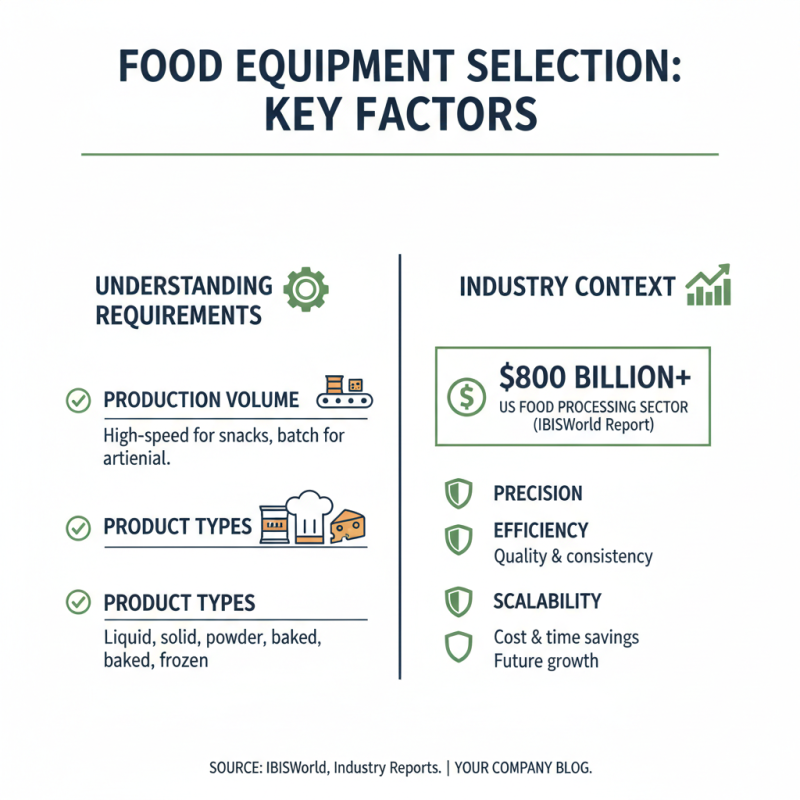
Understanding your food production requirements is crucial when selecting food manufacturing equipment. According to a report by IBISWorld, the U.S. food processing sector is currently worth over $800 billion. This booming industry demands precise equipment tailored to specific production needs. Analyzing production volume and product types is vital. For instance, high-speed packaging equipment may be essential for snacks but less relevant for artisanal foods.

Additionally, regulatory compliance must not be overlooked. The NSF International outlines strict safety standards for food manufacturing. Equipment that doesn't meet these standards can lead to costly recalls. It's essential to prioritize equipment that adheres to FDA regulations. Companies risk severe financial losses and damage to brand reputation otherwise.

One must also consider the future scalability of equipment. Flexibility is often overlooked in initial choices. Equipment that fits current needs might not adapt well to changing production lines. Investing in versatile machinery could save money over time. Balancing initial costs with long-term needs requires careful thought. Each choice should align with production goals and market trends.

Assessing Equipment Compliance with Food Safety Standards

Choosing the right food manufacturing equipment is crucial for safety and efficiency. When assessing equipment compliance with food safety standards, it’s essential to consider several factors. Start by checking if the equipment meets local and international regulations. Certificates from recognized safety organizations can provide assurance. However, not all compliant equipment guarantees quality.

Evaluate the materials used in construction. Stainless steel is often a preferred choice due to its durability and resistance to corrosion. Ensure there are no hidden crevices where bacteria can thrive. Pay attention to the design as well. A complex design might complicate cleaning, leading to potential safety hazards. Equipment that’s difficult to sanitize can pose a serious risk in food production.

Inspect past user reviews and case studies. These real-world experiences can reveal flaws or issues that aren’t evident in specifications. Sometimes, newer models look appealing but may not have proven reliability. Don't overlook the importance of maintenance support as well. Prompt service can help avoid lengthy downtimes. Remember, investment in compliant equipment is an investment in safety.

Food Manufacturing Equipment Compliance Assessment

Evaluating Costs and Budgeting for Equipment Investment

When investing in food manufacturing equipment, careful budgeting is paramount. According to the Food Processing Equipment Market report from 2023, companies should expect a price increase of 5-7% annually. This highlights the need for accurate cost evaluations. Inflation and supply chain issues can inflate initial estimates, making it crucial to factor in these variables early.

Many businesses overlook hidden costs. These can include installation, training, and maintenance expenses. A 2022 study showed that around 30% of equipment acquisition budgets go towards these additional factors. Allocating funds without understanding all associated costs can lead to financial strain. Additionally, purchasing equipment that isn't scalable may limit future growth.

Choosing the right equipment is more than just upfront costs. Regularly assess operational efficiency. For example, equipment that remains idle can lead to unnecessary expenses. This paradox often leads companies to re-evaluate their choices. Compare options thoroughly. Investing in quality equipment can improve long-term productivity, ultimately offsetting higher initial costs. Each choice should be backed by thorough research and a flexible budget to adapt to changes.

Researching Equipment Reliability and Maintenance Needs

When selecting food manufacturing equipment, reliability is crucial. A machine that frequently breaks down can cause delays. Research thoroughly to ensure the equipment is designed for durability. Look for reviews from other manufacturers. Read case studies that discuss long-term usage. This will give insight into the equipment’s performance over time.


Maintenance needs are equally important. Every piece of equipment requires regular upkeep. Understand what maintenance entails for each machine. Some may need parts replaced often, while others are more forgiving. Schedule routine checks to avoid unexpected failures. It’s easy to overlook, but neglecting maintenance can cost more in the long run. Keep a log of all maintenance activities; it helps identify patterns and future issues.

Exploring Technological Advancements in Food Manufacturing Equipment

The landscape of food manufacturing equipment is changing rapidly. New technologies emerge every year. These advancements improve efficiency and reduce waste. Automation and robotics play a key role. They can handle tasks like packaging and sorting. This reduces the need for manual labor. As a result, companies see increased productivity.

Moreover, energy-efficient machines are now the standard. They not only help save costs but also promote sustainability. Advanced sensors provide real-time data monitoring. This ensures consistent quality and aids in maintenance. However, technology can sometimes be overwhelming. Selecting the right equipment without proper understanding can lead to mistakes. Investing in training for staff is crucial.

Choosing equipment that integrates well with existing systems can be challenging. Compatibility issues may arise, causing disruptions. It's important to weigh the benefits of new features against long-term commitments. Evaluating your specific needs before diving into new tech is vital. Not every shiny gadget will fulfill your requirements. Be cautious and reflect on your choices to avoid pitfalls.

10 Essential Tips for Choosing Food Manufacturing Equipment - Exploring Technological Advancements in Food Manufacturing Equipment

Tip Number Tip Description Technological Advancement Benefits
1 Assess Production Needs Artificial Intelligence for Analysis Optimizes production schedules and reduces downtime
2 Evaluate Equipment Flexibility Modular Equipment Design Easy to adapt to changing product lines
3 Consider Energy Efficiency Smart Energy Management Systems Reduces operational costs and environmental impact
4 Prioritize Safety Features Advanced Safety Sensors Enhances workplace safety for employees
5 Look for Regulatory Compliance Built-in Compliance Software Ensures adherence to food safety standards
6 Investigate Maintenance Requirements Predictive Maintenance Technologies Minimizes unexpected equipment failures
7 Analyze Cost and ROI Cost-Benefit Analysis Tools Provides clear financial insights before purchase
8 Seek User-Friendly Interfaces Touchscreen Control Panels Improves operation efficiency and training time
9 Ensure Compatibility with Existing Systems IoT Integration Capabilities Supports seamless communication across processes
10 Plan for Future Growth Scalable Technology Solutions Facilitates long-term business expansion